

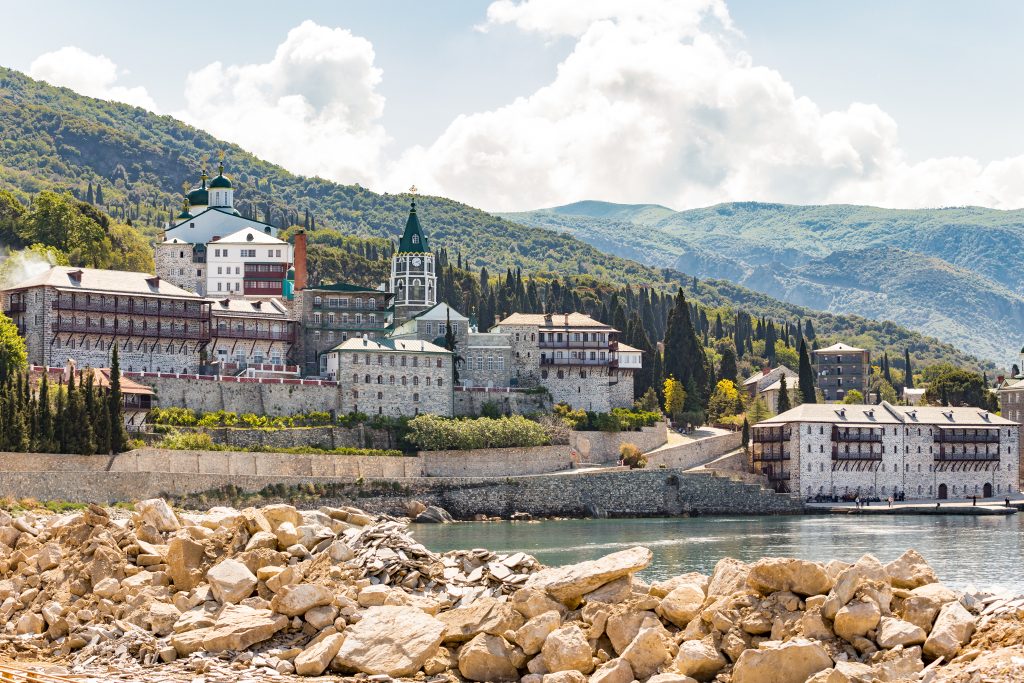
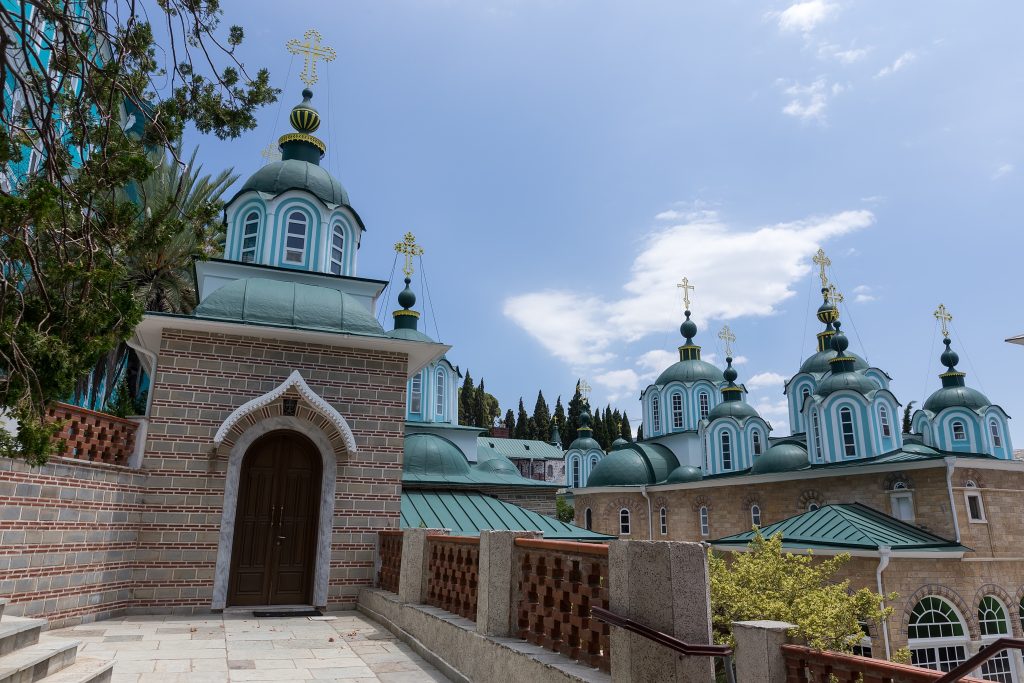
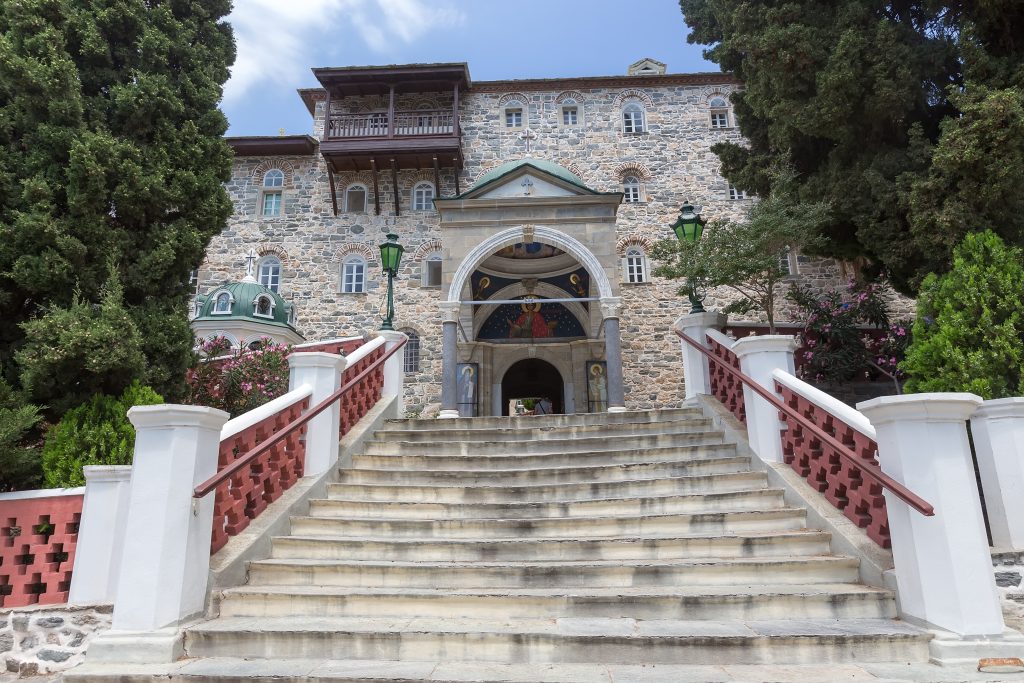
Saint Panteleimonos Monastery, widely known as the Russian Monastery of Mount Athos, is one of the most imposing and distinctive landmarks along the southwestern coastline of the Holy Mountain. Closely associated with the Russian Orthodox tradition, its scale and architectural density immediately set it apart from all other monasteries visible from the sea.
From the water, the monastery presents a powerful and expansive presence. Large multi-story buildings line the shoreline, forming a monastic complex that feels closer to a small settlement than a single enclosed monastery. This distinctive appearance reflects both its historical development and its longstanding Russian spiritual identity.
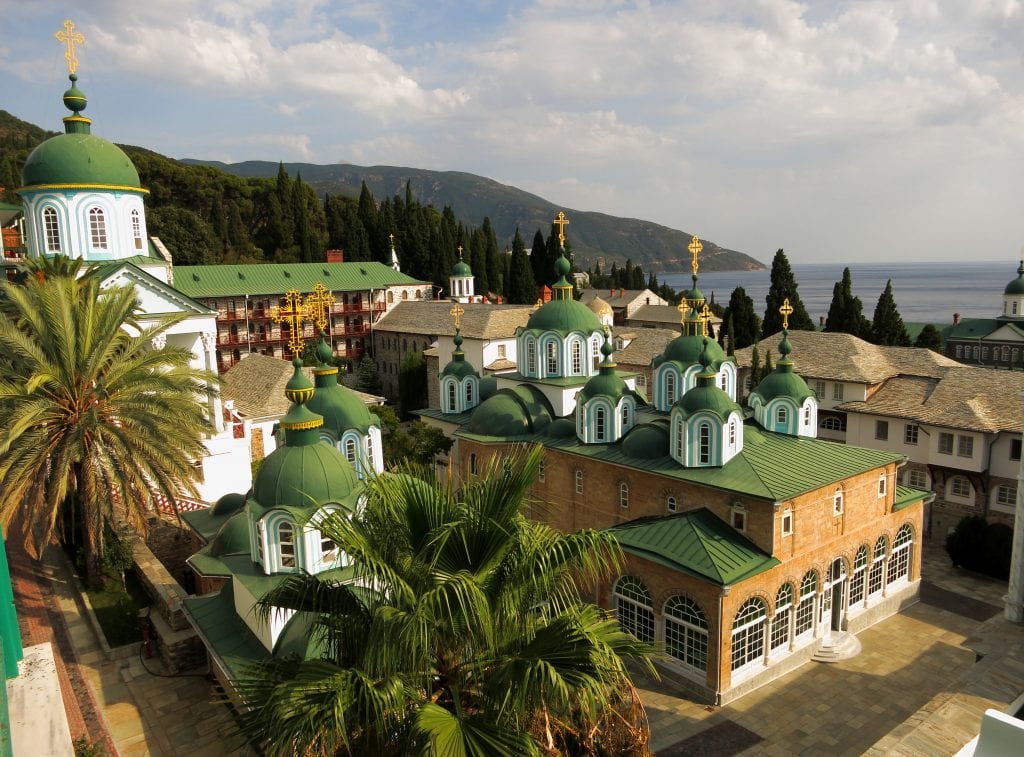
Table of Contents
Where Saint Panteleimonos Monastery appears on the Mount Athos sea route
During the coastal sea journey along Mount Athos, Saint Panteleimonos Monastery appears along the southwestern side of the peninsula, positioned between the monasteries of Xenophontos and Xenophontos’ southern neighbors. Its location along the shoreline allows for a clear and uninterrupted view as the vessel approaches this part of the route.
From the sea, the monastery’s extensive waterfront façade becomes immediately noticeable. The buildings stretch horizontally along the coast, emphasizing scale and continuity rather than vertical elevation. This placement allows passengers to observe the monastery for an extended period, making it one of the most visually prominent landmarks along the route.
For many visitors, this section of the journey feels particularly distinctive. The monastery’s size and architectural density signal a transition within the sequence of southwestern monasteries, highlighting its unique role within the Mount Athos coastal landscape.
Why Saint Panteleimonos is known as the Russian Monastery of Mount Athos
Saint Panteleimonos Monastery is widely recognized as the Russian Monastery of Mount Athos due to its long-standing historical and spiritual connection with the Russian Orthodox world. From the 18th century onward, the monastery became a central spiritual hub for Russian monks, pilgrims and ecclesiastical figures, shaping its identity in a way unmatched by any other Athonite monastery.
This strong Russian presence influenced not only the monastery’s spiritual life but also its physical expansion. As the monastic community grew, especially during the 19th and early 20th centuries, the monastery expanded significantly to accommodate large numbers of monks arriving from Russia. This period marked the transformation of Saint Panteleimonos Monastery into one of the largest monasteries on Mount Athos.
The monastery’s architecture reflects this history. The scale, layout and density of its buildings echo the organizational needs of a large monastic population, while maintaining Orthodox spiritual discipline. From the sea, this development is clearly visible, reinforcing the monastery’s identity as a distinct and powerful presence along the southwestern coastline.
Despite historical changes and periods of transition, Saint Panteleimonos Monastery has retained its Russian spiritual character. Today, it continues to symbolize the deep historical ties between Mount Athos and Russian Orthodoxy, making it a unique spiritual landmark within the Athonite world.
What visitors notice when viewing Saint Panteleimonos from the sea
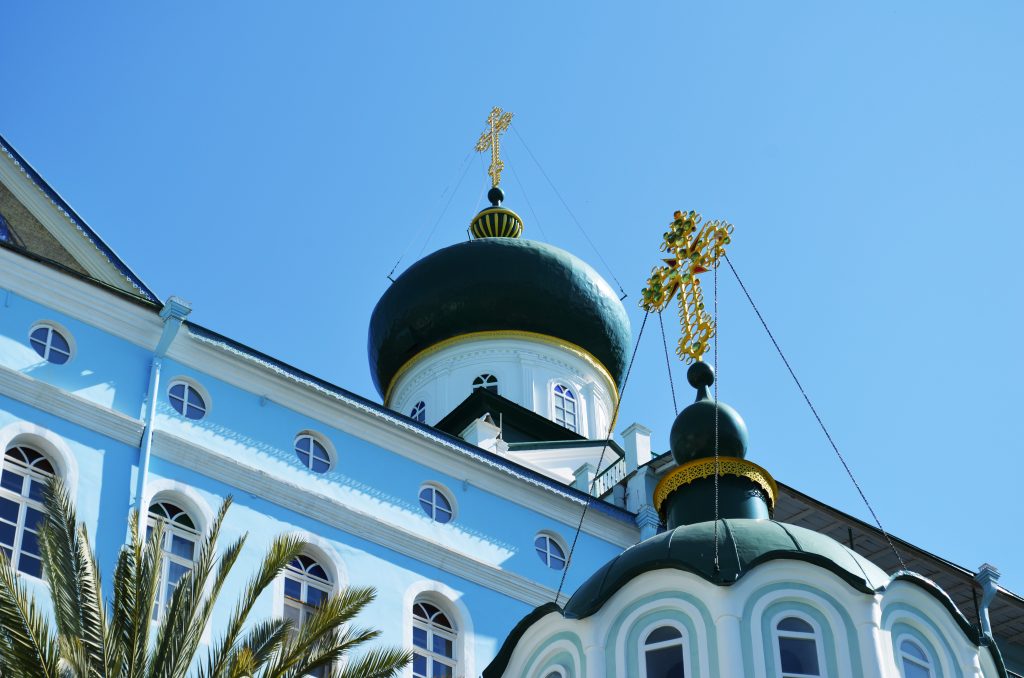
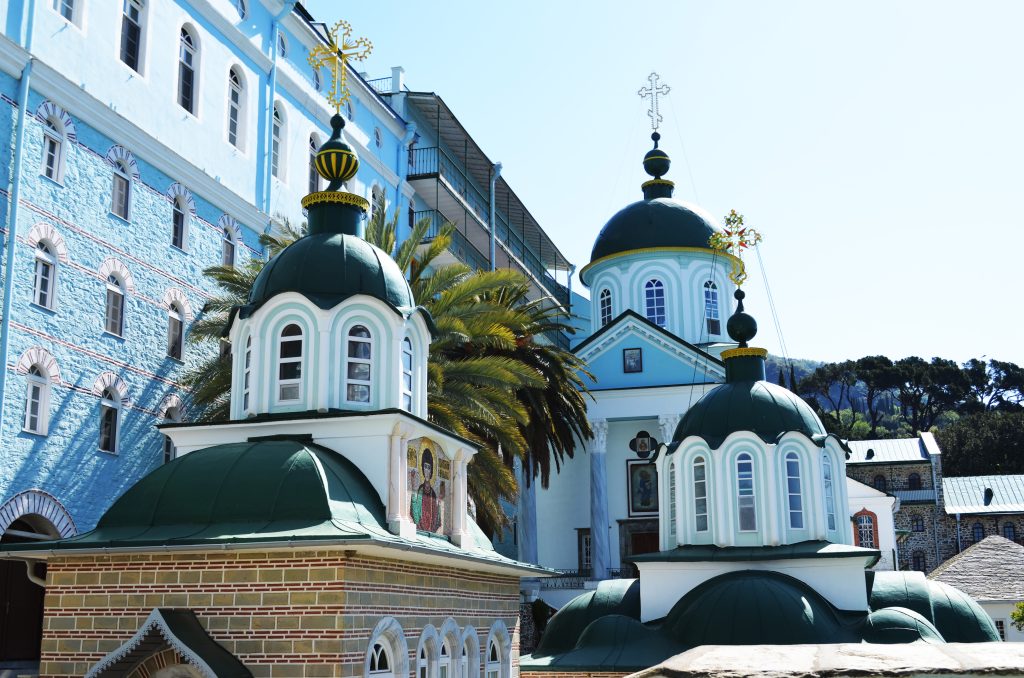
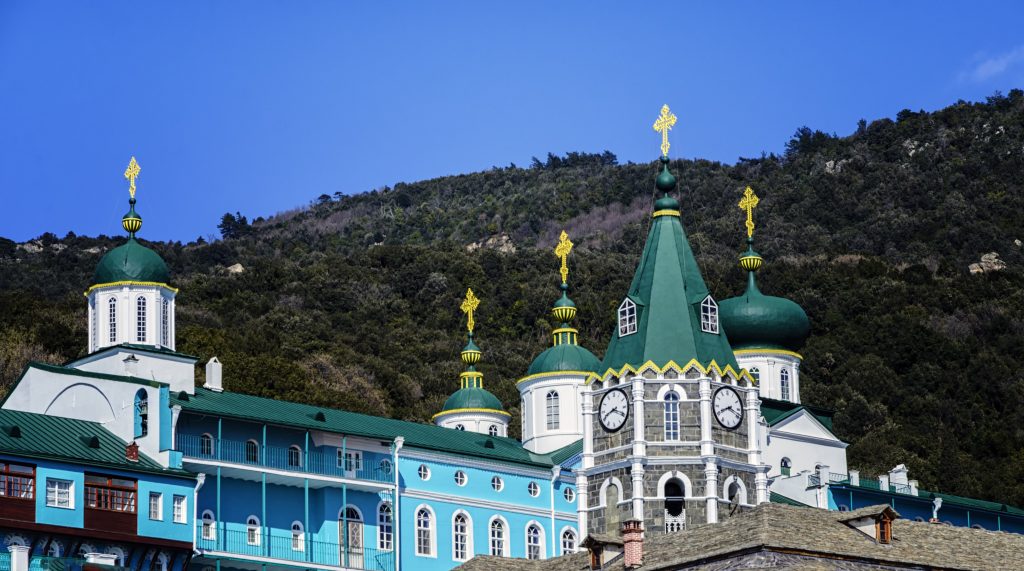
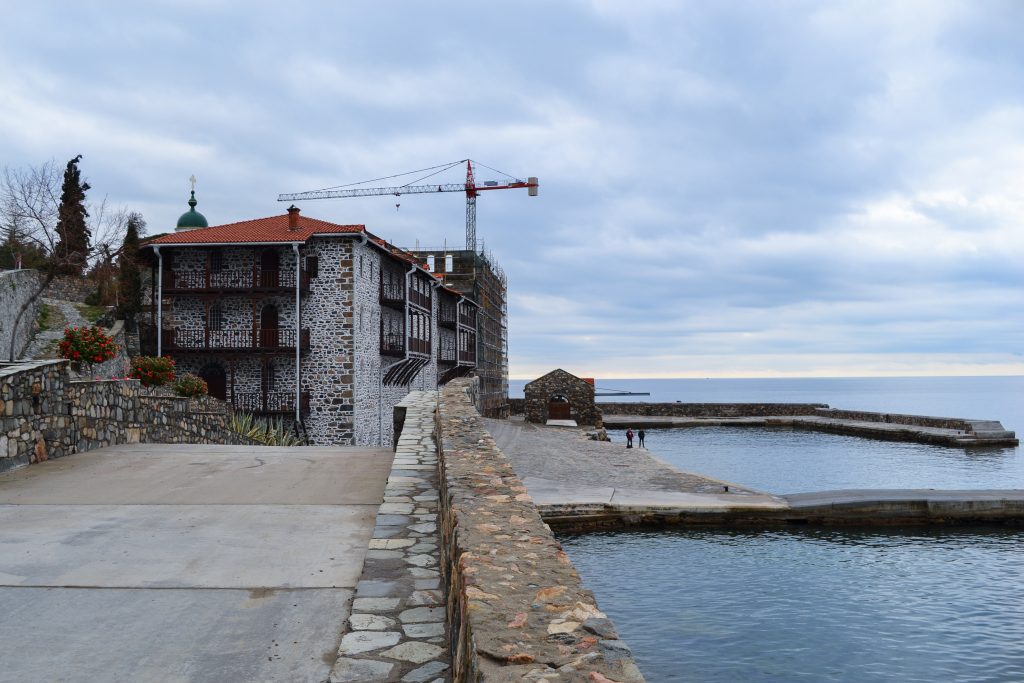
As the vessel approaches this section of the coastline, visitors immediately notice the sheer scale of Saint Panteleimonos. Unlike most monasteries on Mount Athos, which appear compact or vertically oriented, this monastery unfolds as a broad and extensive complex stretching along the shoreline.
From the sea, the architecture feels dense and structured, with multiple large buildings forming a continuous façade. The repetition of windows, roofs and architectural lines creates a rhythm that reinforces the sense of order and organization within the monastic settlement. This visual density sets Saint Panteleimonos apart from its neighboring monasteries.
Another striking element is the monastery’s openness toward the sea. Its placement allows for long and uninterrupted viewing, giving passengers time to absorb details and scale without the need for rapid observation. The experience feels less fleeting and more immersive compared to other points along the route.
For many visitors, this moment stands out as one of the most memorable along the Mount Athos sea journey. The monastery’s imposing presence communicates stability, endurance and collective life, offering a powerful visual expression of its historical and spiritual significance.
How Saint Panteleimonos Monastery fits into the Mount Athos cruise experience
Within the overall flow of the journey, Saint Panteleimonos Monastery represents a moment of scale and intensity. By the time the vessel reaches this section of the coastline, visitors have already encountered several monasteries with distinct identities, yet none compare in size or visual density to this one.
In the context of Mount Athos cruises, Saint Panteleimonos often feels like a turning point in perception. The experience shifts from observing individual monastic landmarks to witnessing a fully developed monastic settlement. Its extensive layout and architectural rhythm communicate collective life, organization and continuity on a much larger scale.
This part of the route encourages a different type of observation. Rather than focusing on a single façade or elevation, visitors take in the monastery as a whole, understanding its role as a major spiritual and historical center within Mount Athos. The prolonged visibility from the sea allows time for reflection and appreciation of its magnitude.
Those who wish to see how Saint Panteleimonos fits within the broader sequence of coastal landmarks can explore the complete overview of Mount Athos cruises, which explains the route and progression of monasteries visible from the sea.
The history and spiritual significance of Saint Panteleimonos Monastery
Saint Panteleimonos Monastery, known in Greek as Agios Panteleimonos, was founded in the 11th century and gradually developed into one of the most influential monastic centers on Mount Athos. Although its early years were modest, its destiny became closely intertwined with the growth of Russian Orthodox monasticism.
From the 18th century onward, the monastery experienced significant expansion due to the increasing presence of Russian monks. By the 19th century, Saint Panteleimonos had become the primary spiritual home for thousands of Russian monks on Mount Athos, transforming it into one of the largest monastic communities of the Holy Mountain.
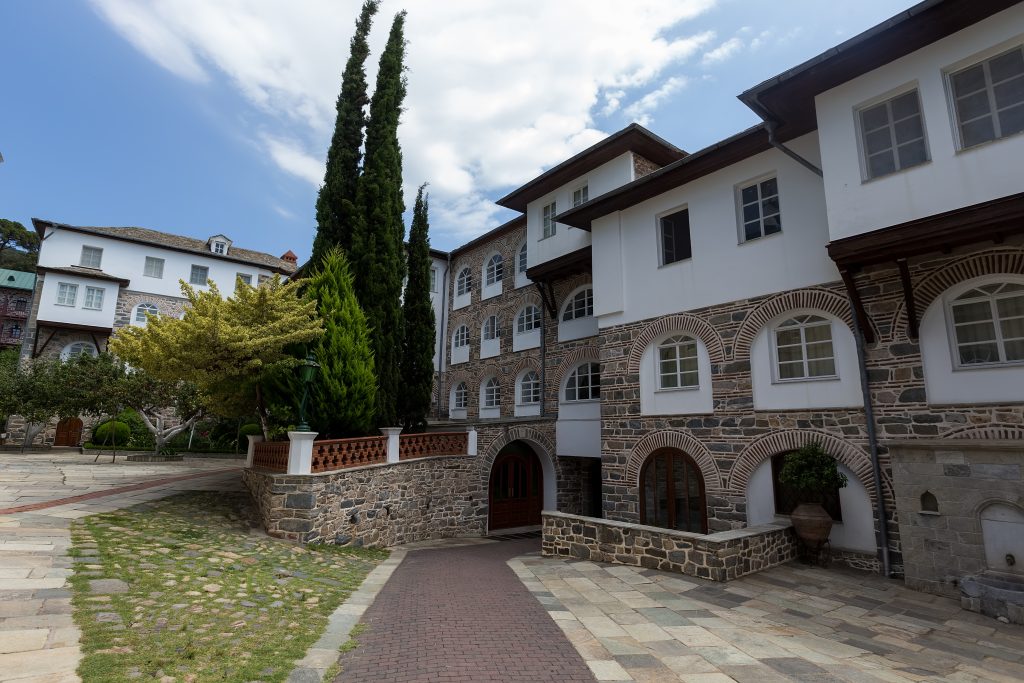
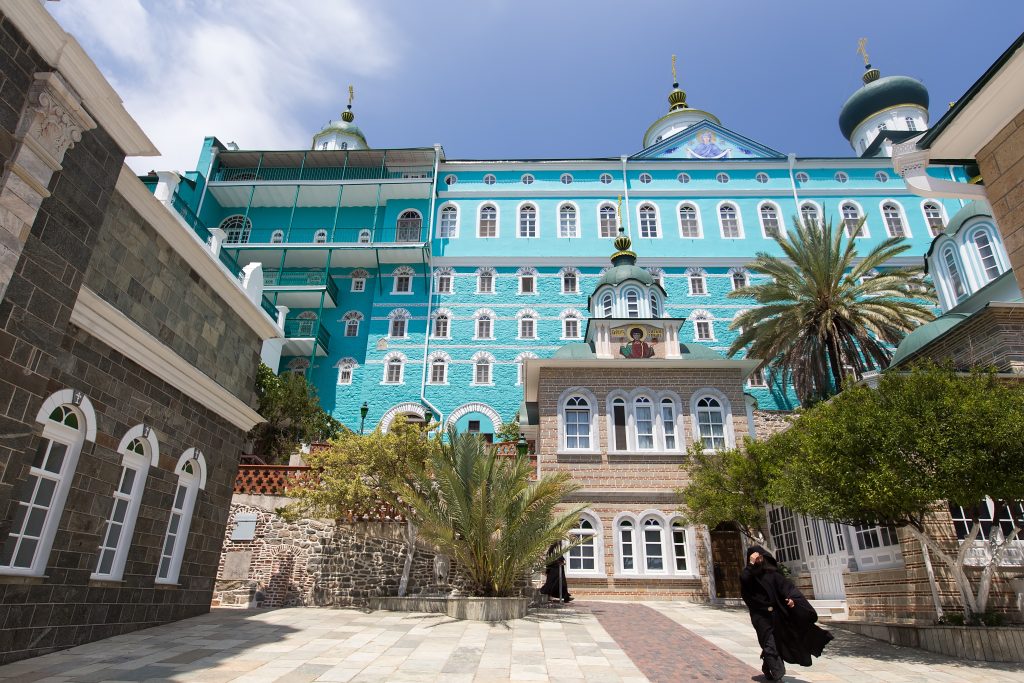
This period of growth shaped not only the monastery’s spiritual life but also its physical form. Large multi-story buildings were constructed to support communal worship, daily labor and monastic discipline on a scale unseen elsewhere on Athos. The monastery’s size and organization reflect its role as a major spiritual center serving a vast monastic population.
Monastic identity and daily life
Saint Panteleimonos is an Orthodox monastery of Russian tradition, while remaining an integral part of the Athonite monastic community. Its monks follow the traditional rhythm of Mount Athos, centered on prayer, communal worship, obedience and daily responsibilities.
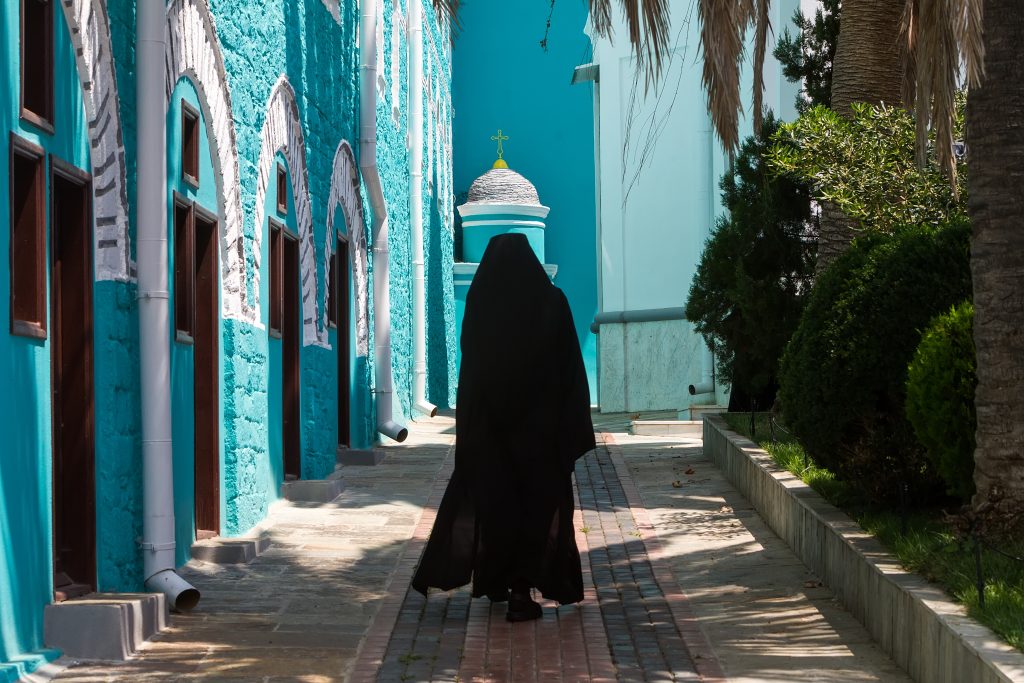
Despite its size, the monastery preserves a strong sense of order and spiritual discipline. Life within its walls is structured around liturgical services, monastic duties and collective life, reflecting centuries of continuity within the Russian Orthodox spiritual tradition.
A bridge between Mount Athos and the Russian Orthodox world
The monastery has long served as a spiritual bridge between Mount Athos and the Russian Orthodox Church. Throughout its history, it has welcomed monks, pilgrims and benefactors from Russia, strengthening cultural and spiritual ties that continue to shape its identity today.
This connection elevated Saint Panteleimonos Monastery beyond a regional monastery, establishing it as a symbol of international Orthodox unity and spiritual exchange.
Why this history matters to the visitor
Understanding the historical role of Saint Panteleimonos adds depth to the experience of viewing it from the sea. What appears as an imposing architectural complex is, in reality, the result of centuries of spiritual growth, devotion and cross-cultural monastic life.
For many visitors, this knowledge transforms the visual encounter into a deeper appreciation of Mount Athos as a place where faith, history and international Orthodox tradition converge.
Beyond individual landmarks, Mount Athos functions as a living monastic community, a subject explored through a broader introduction to its spiritual and historical framework.
Sacred treasures and holy relics preserved at Saint Panteleimonos Monastery
Saint Panteleimonos Monastery preserves an exceptionally rich collection of sacred treasures and holy relics, reflecting its historical role as the spiritual heart of Russian Orthodox monasticism on Mount Athos. These treasures place the monastery among the most significant custodians of Orthodox heritage on the Holy Mountain.
Holy relics of saints
Among the most revered relics preserved at Saint Panteleimonos Monastery are relics of saints deeply venerated within Orthodox Christianity, including:
- Saint Panteleimon the Healer – the monastery’s patron saint, widely honored for healing, compassion and intercession
- Saint John Chrysostom – one of the greatest Church Fathers and architects of Orthodox theology and liturgy
- Saint Basil the Great – a foundational figure of monasticism and ecclesiastical organization
- Saint Gregory the Theologian – one of the Cappadocian Fathers and a central voice in early Christian doctrine
- Saint Seraphim of Sarov – one of the most beloved saints of the Russian Orthodox tradition
These relics are venerated during major feast days and liturgical services, forming a central part of the monastery’s spiritual life and reinforcing its role as a place of prayer, healing and intercession.
Venerated icons of Russian Orthodox tradition
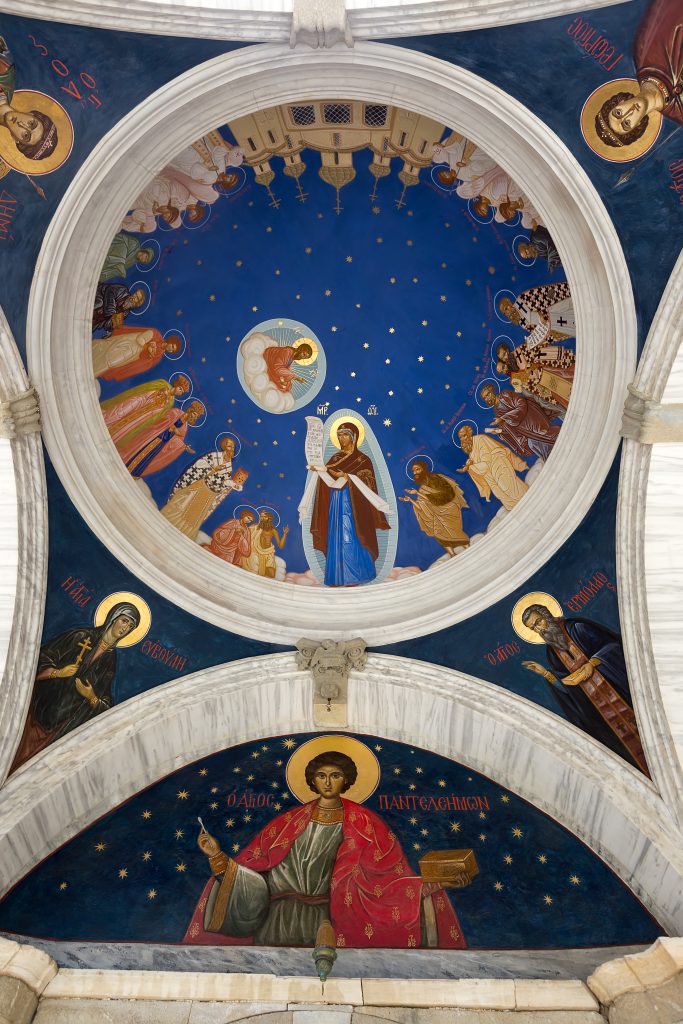
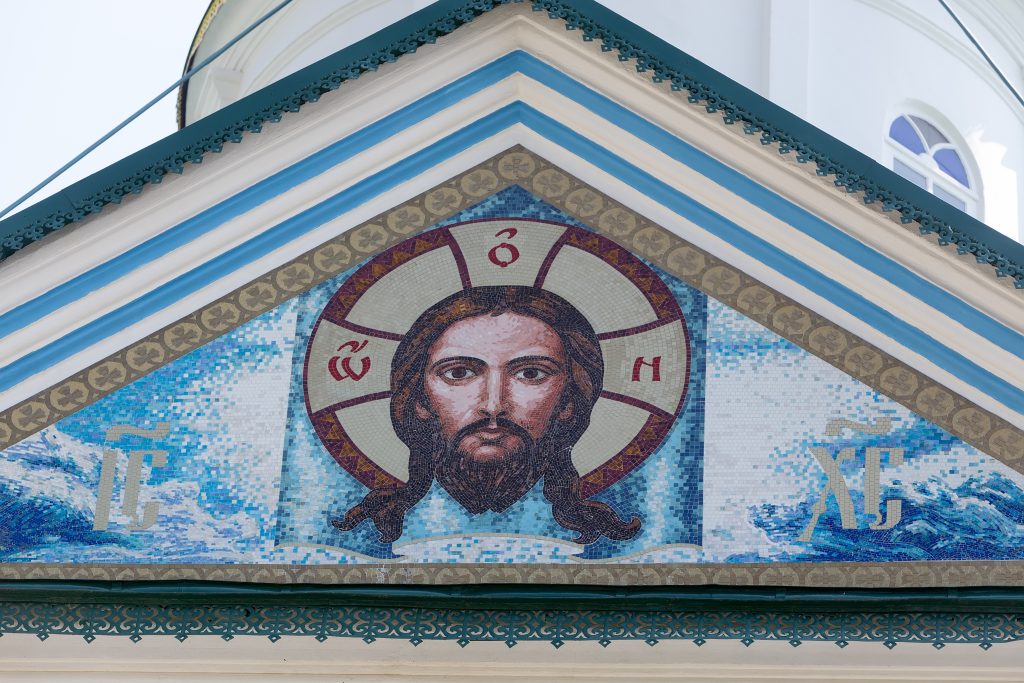
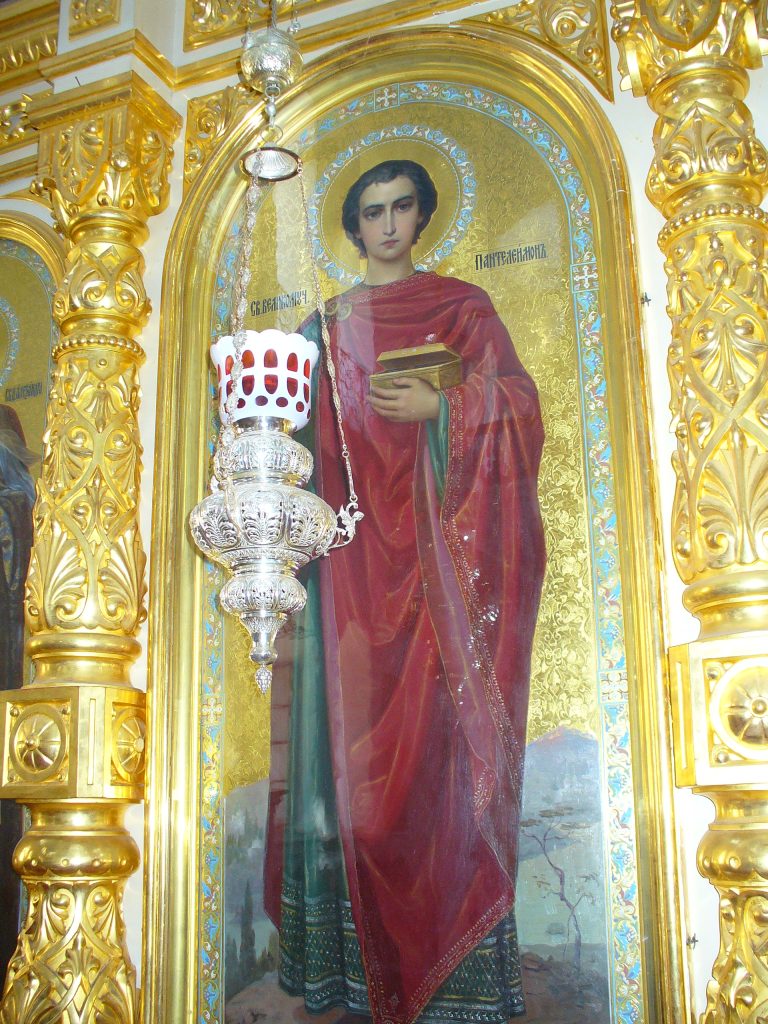
The monastery safeguards a remarkable collection of venerated icons, many of which originate from the Russian Orthodox world. These icons reflect centuries of devotional art and spiritual continuity, serving as focal points for daily worship.
Among them are icons of:
- Saint Panteleimon
- The Virgin Mary
- Christ Pantocrator
These icons are not preserved merely as artistic works, but as living elements of prayer and spiritual practice within the monastery.
Manuscripts and ecclesiastical heritage
Saint Panteleimonos holds an important archive of manuscripts and ecclesiastical documents, including:
- liturgical books in Church Slavonic
- theological texts of Russian and Byzantine origin
- historical records documenting the monastery’s development and monastic life
This collection highlights the monastery’s role as a guardian of Orthodox learning and its contribution to the transmission of spiritual knowledge between Mount Athos and the Russian Orthodox world.
Liturgical vessels and sacred objects
Among the monastery’s treasures are valuable liturgical objects, such as:
- hand-crafted chalices and censers
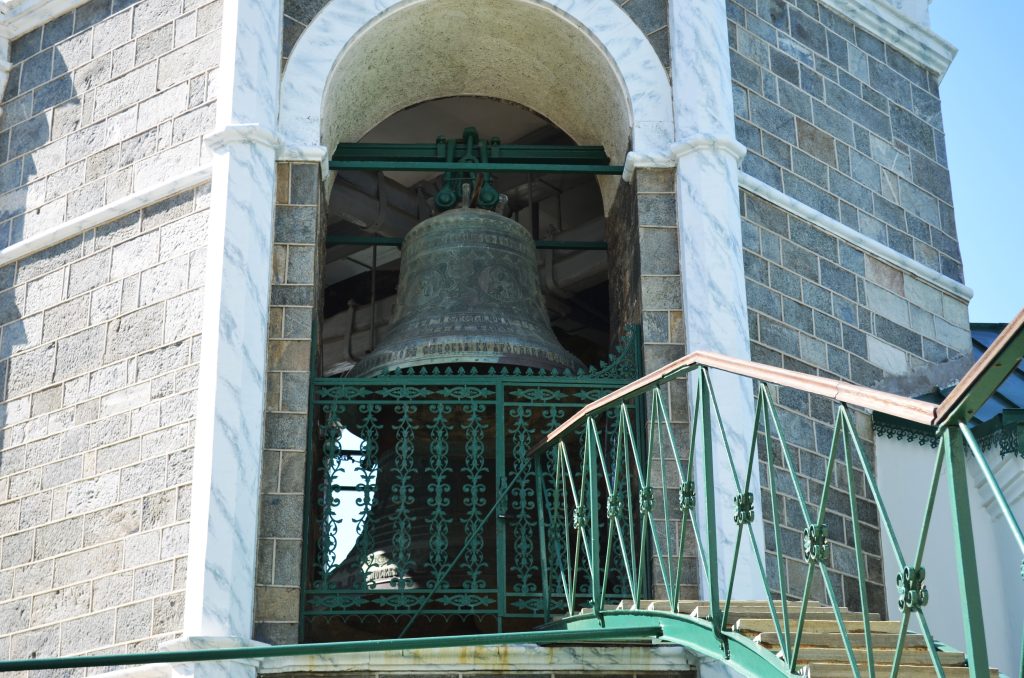
- crosses and sacred vessels
- embroidered vestments used in major feast-day services
Many of these objects remain in active liturgical use, reinforcing the monastery’s living spiritual character rather than presenting it as a static historical institution.
Why these treasures matter to the visitor
Although these sacred treasures are not visible during a sea journey, understanding what is preserved within Saint Panteleimonos Monastery adds profound depth to the viewing experience. The vast monastic complex seen from the water protects a spiritual heritage shaped by centuries of devotion, healing and Orthodox unity.
For many readers, this awareness transforms the monastery from an imposing architectural landmark into a living spiritual center of international Orthodox significance.
Closing – Seeing Saint Panteleimonos with understanding
Viewing Saint Panteleimonos from the sea leaves a powerful and lasting impression. Its scale, architectural density and openness toward the coastline reflect centuries of spiritual growth and collective monastic life, setting it apart from all other monasteries on Mount Athos.
Beyond its imposing exterior lies a spiritual heritage shaped by prayer, healing and devotion, deeply rooted in the Russian Orthodox tradition. For many visitors, understanding this background transforms the moment of observation into a deeper appreciation of Mount Athos as a place where faith and history converge on an international scale.
Readers interested in an overview of all monasteries of the Holy Mountain can explore a comprehensive guide covering the full monastic landscape of Mount Athos here.
How visitors can view Saint Panteleimonos Monastery from the sea
Visitors can observe Saint Panteleimonos as part of a coastal sightseeing journey along the Holy Mountain. One of the established sea routes departs from Ouranoupoli and follows the traditional southwestern passage, offering extended and unobstructed views of the monastery from the water.
More information about the route, sailing schedule and availability can be found on the Mount Athos coastal cruise from Ouranoupoli.
Frequently Asked Questions about Saint Panteleimonos Monastery
Why is Saint Panteleimonos known as the Russian Monastery of Mount Athos?
The monastery developed strong historical and spiritual ties with the Russian Orthodox world, especially from the 18th century onward, becoming the main spiritual center for Russian monks on Mount Athos.
Is Saint Panteleimonos an active monastery today?
Yes. Saint Panteleimonos remains an active Orthodox monastery with a living monastic community following the Athonite tradition.
What makes Saint Panteleimonos stand out among Mount Athos monasteries?
What makes Saint Panteleimonos stand out among Mount Athos monasteries?
Can visitors enter Saint Panteleimonos during a cruise?
No. Visitors observe the monastery exclusively from the sea. Entry to Mount Athos monasteries requires an official access permit.
Did you find our post helpful?
- Was this post helpfull?
- Rate us on TripAdvisor
This article made by https://lnk.bio/Rodokalakis
